
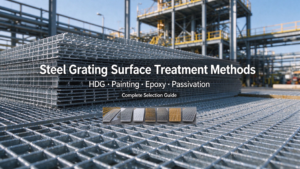
Steel grating surface treatment directly determines its corrosion resistance, service life, appearance, and overall project cost. Different working environments require different finishing processes. Choosing the right surface treatment can effectively reduce maintenance costs and extend grating service time for industrial platforms, walkways, drainage covers, power stations, chemical plants, and municipal projects.
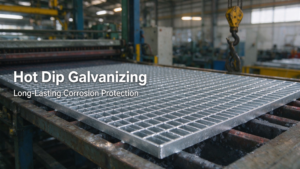
1. Hot Dip Galvanizing (HDG)
Hot dip galvanizing is the most popular and standard surface treatment for carbon steel grating. After fabrication, the steel grating is fully dipped in molten zinc, forming a thick, bonded zinc alloy layer on the steel surface.
This treatment provides both physical barrier protection and sacrificial anode protection. Even if the surface has minor scratches, the zinc layer can continue to protect the steel from rust.
Features & Advantages
• Long service life: 20–30 years outdoor
• Strong adhesion, not easy to peel off
• Excellent rust resistance for humid, outdoor, coastal environments
• Zero maintenance in most industrial scenarios
Best Application
Factory walkways, power stations, port terminals, municipal drainage, outdoor engineering projects.
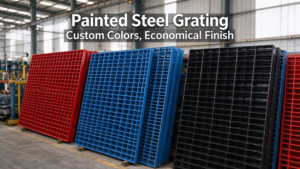
2. Spray Painting / Paint Coating
Painted steel grating is an economical surface solution for indoor and low-corrosion environments. The surface is cleaned and sprayed with industrial anti-rust paint or topcoat paint.
Features & Advantages
• Low production cost, fast delivery
• Customizable colors to match equipment and building style
• Basic anti-rust performance for dry indoor use
Disadvantages
Easy to scratch and peel under outdoor, wet or heavy-friction conditions; requires regular repainting.
Best Application
Indoor workshops, mechanical equipment supporting grating, temporary facilities, low-budget indoor projects.
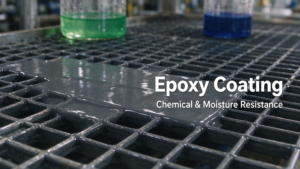
3. Epoxy Coating
Epoxy coating is a high-grade anti-corrosion treatment for harsh industrial environments. The epoxy resin layer provides excellent resistance against acid, alkali, chemical liquid and moisture erosion.
Features & Advantages
• Super chemical corrosion resistance
• Smooth surface, dust-proof and easy to clean
• Strong abrasion resistance
Best Application
Chemical plants, sewage treatment plants, pharmaceutical factories, environments with chemical erosion.
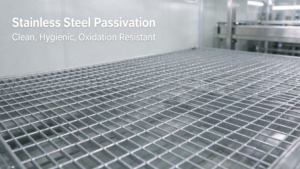
4. Stainless Steel Passivation
Stainless steel grating usually adopts passivation treatment. After polishing and cleaning, a dense chromium oxide protective film forms on the surface, improving its inherent anti-rust performance. No extra coating is added.
Features & Advantages
• No coating falling off
• Clean surface, hygienic, food-grade available
• Good resistance to weak acid and oxidation
Best Application
Food processing workshops, beverage factories, medical industries, clean workshops.
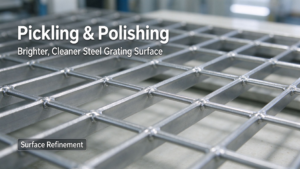
5. Pickling & Polishing
Pickling and polishing is mainly used for stainless steel grating. It removes surface oxide scale, welding spots and stains, getting a bright, smooth metal surface.
Features & Advantages
• Beautiful metallic luster
• Easy to check welding quality
• Good for places with high appearance requirements
Disadvantages
No extra heavy anti-corrosion layer, not suitable for strong corrosive environments.
Best Application
Food equipment, clean rooms, exhibition platforms, decorative grating.
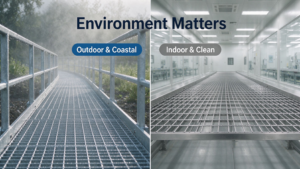
How to Choose the Right Surface Treatment
• Outdoor, coastal, long-term use: Hot dip galvanizing
• Indoor, dry, limited budget: Spray painting
• Chemical, wastewater, acid & alkali environment: Epoxy coating
• Food, medical, clean workshop: Stainless steel passivation / polishing
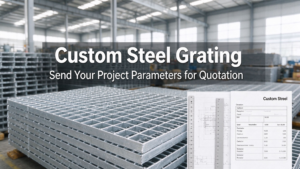
Conclusion
There is no universal surface treatment for steel grating. The selection depends on corrosion level, indoor or outdoor conditions, budget and hygiene requirements. If you need custom steel grating with specified surface treatment, send us your project parameters for quotation.