
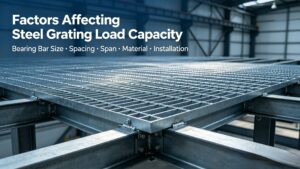
Steel grating is widely used for industrial platforms, walkways, stair treads, drainage covers, and factory flooring. For engineering buyers and project contractors, load capacity is the most critical performance index.
Many customers wonder why steel grating with the same appearance may have completely different bearing performance.
In fact, the load capacity of steel grating is affected by material grade, bearing bar size, bar spacing, span length, welding quality, surface treatment and installation method.
Understanding these factors helps you select suitable steel grating to avoid deformation, bending, safety risks and project rework.
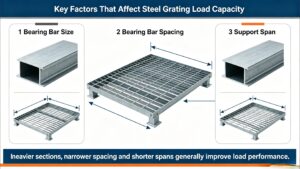
1. Bearing Bar Size (Core Factor)
The bearing bar is the main load-bearing part of steel grating.
– Bearing bar height: The higher the bar, the stronger the bending resistance and the higher the load capacity. It is the most influential factor for long-span grating.
– Bearing bar thickness: Thicker bars improve compression resistance, impact resistance and overall structural stability.
Standard bearing bar sizes: 20mm, 25mm, 30mm, 32mm, 40mm, 50mm.
Larger and thicker bearing bars directly upgrade the maximum safe load of steel grating.
2. Bearing Bar Spacing
Bar spacing refers to the center distance between two adjacent bearing bars.
Common spacing: 30mm, 40mm, 60mm.
– Smaller spacing: More steel bars per square meter, uniform force distribution, higher load capacity.
– Larger spacing: Reduces material cost but decreases overall bearing performance.
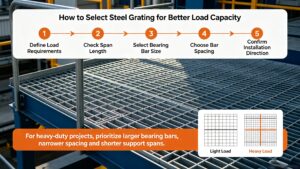
For heavy-load scenarios (forklift passage, mechanical platform), narrow spacing grating is strongly recommended.
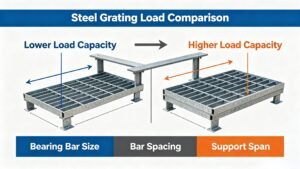
3. Span Length Between Supports
Span means the distance between two supporting steel beams.
Span length is inversely proportional to load capacity.
– Shorter span: small deflection, stable bearing capacity
– Longer span: easy to bend, greatly reduced load limit
Even heavy-duty steel grating cannot bear heavy loads if the support span is too large. Reducing the span is the most effective way to improve safety.
4. Raw Material Grade
Different steel materials have different mechanical strength:
– Carbon steel / Mild steel: High hardness, strong bearing capacity, most used for industrial heavy load projects
– Stainless steel: Good corrosion resistance, relatively lower yield strength than carbon steel
– Galvanized steel: Based on carbon steel, stable comprehensive performance
Material quality directly determines the ultimate load limit of steel grating. Low-quality recycled steel will cause bending and deformation under normal load.
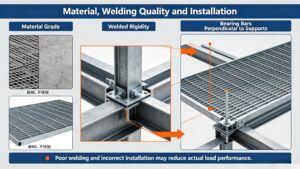
5. Welding Process and Manufacturing Quality
High load capacity requires stable welding structure.
– Full automatic pressure welding ensures tight combination of bearing bars and cross rods
– No missing welding, no virtual welding
– Uniform solder joints improve overall structural rigidity
Poor welding leads to loose structure, local stress concentration and reduced service load capacity.
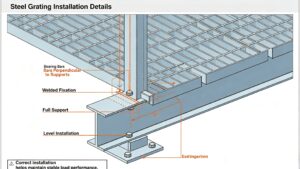
6. Installation Method and Support Condition
Installation details greatly affect actual bearing performance:
– Bearing bars must be perpendicular to the support beam
– Welded fixation provides higher stability than clip fixation
– Flat and full support surface avoids local suspension
– Correct installation direction prevents excessive deflection
Many grating deformation problems on site are caused by incorrect installation rather than product quality.
7. Surface Treatment and Service Environment
Hot-dip galvanized treatment does not change the original bearing capacity, but protects the steel structure.
– Anti-rust and anti-corrosion performance avoids metal thinning caused by oxidation
– Long-term stable structure maintains rated load capacity
In humid, chemical and outdoor environments, unprotected steel grating will gradually lose load performance.
Conclusion
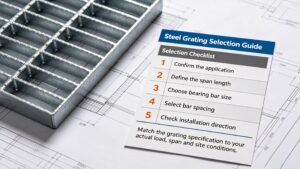
The load capacity of steel grating is mainly determined by bearing bar size, bar spacing, support span and raw material grade. Welding quality and installation methods also play a decisive role in actual engineering performance.
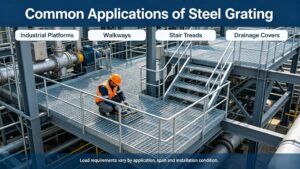
For pedestrian walkways, drainage covers, light-load platforms, standard grating meets the demand.
For forklift passages, heavy machinery platforms and long-span projects, it is necessary to increase bar height, reduce spacing and shorten support span.
We provide custom steel grating with different load grades for industrial, municipal and construction projects. Send your span size and load requirement to get a professional quotation.